Window Cleaning Equipment for Beginners: A Practical Starter Guide
Updated: Sep 14
A beginner does not need every specialized window-cleaning tool. A small, well-chosen kit is better than a large collection you do not yet know how to use.
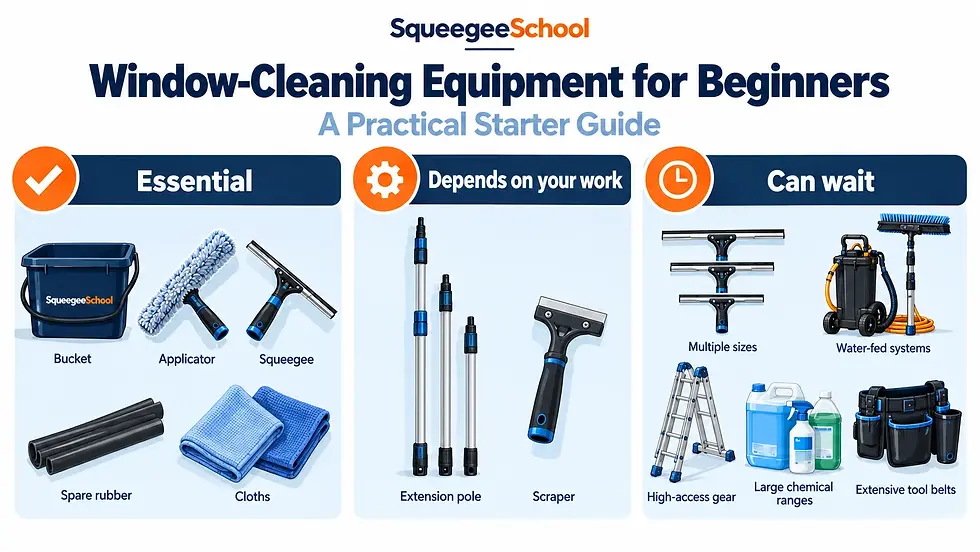
The essential starting point is an applicator, a squeegee, suitable cloths, a bucket and a safe way to manage the working area. An extension pole becomes useful when the glass cannot be reached comfortably by hand.
1. Bucket
A bucket carries the cleaning solution and allows the applicator to be loaded evenly. A rectangular 22L window-cleaning bucket is usually easier to use with a full-width 45cm applicator than a small round household bucket.
Choose a size you can carry safely when filled. More capacity is not automatically better.
2. Applicator, T-bar and sleeve
The applicator wets and agitates the glass before the water is removed. It consists of a handle and T-bar with a removable sleeve.
For a beginner, the important considerations are:
• a comfortable grip;
• a sleeve that can be removed and cleaned;
• a width suited to the glass being practised on; and
• secure attachment if it will be used with a pole.
Applicators come in all sizes; the most common one is 45cm and will fit perfectly in a 22L bucket. The applicator is not simply used to spread water. It helps loosen surface soil. There are a number of different types of sleeves you can get for your applicator from ones that soak and hold lots of water to ones that have partial scrubbing pads to break up heavy residue.
3. Squeegee
The squeegee controls and removes water from the glass. It normally consists of a handle, channel and replaceable rubber.
A professional-quality tool does not create a professional result by itself. The finish still depends on blade condition, angle, pressure, movement and water control.
Beginners often assume they need to press harder when water remains. Excessive pressure can increase effort and make the movement less controlled. The better response is to examine the rubber, angle and contact across the stroke.
Like applicators, Squeegee channels come in all range of sizes. in 90% of cases, you only need two, a 45cm channel and a 30cm channel.
When it comes to squeegees, bigger is not better. The larger the squeegee channel, the more pressure required to keep a perfect seal between the rubber and the glass. If you are inexperienced, you will find the 30cm channel the easiest to master, then move onto the 45cm.
Squeegee handles also come in a range of varieties, but my suggestion is learn to master the wagtail. It's swivel head gives it greater flexibility to reach awkward angles and allows for better flow and movement.
4. Replacement rubber
The rubber edge is a working component, not a permanent part of the tool. Worn, damaged or poorly seated rubber can contribute to lines and inconsistent water removal.
Keep replacement rubber clean and protected in storage. Learn how to inspect and change it rather than treating the complete squeegee as disposable.
New rubbers slide against the glass with little to no effort, whereas worn out rubbers require more effort and pressure. Be careful with how you store your squeegee. The rubber can be bent out of shape or knicked and cause streaks
5. Detailing cloths
Cloths are used for controlled edge detailing, wiping frames where appropriate and managing small amounts of water. They should support the technique rather than compensate for incomplete squeegee work across the entire pane. Make sure your clothes are 100% cotton for the best absorption.
A wet or contaminated detailing cloth can transfer marks back onto clean glass. The better your squeegee technique, the less you have to touch up with a rag.
6. Extension pole
An extension pole allows ground-based reach on suitable glass. It also magnifies small control problems. Twisting, overreaching or changing pressure through the movement can become more obvious as the pole extends.
Practice with modest reach first. Control should come before height or speed.
Extension poles come in all sorts of heights from 1m up to several meters. Make sure to buy a carbon fibre extension pole. They are strong and very light weight in comparison to other poles. They have a number of attachable extensions and can be upgraded to make them longer.
7. Scraper blade — not an automatic beginner tool
Scraper blades can remove specific contamination, such as stickers, glue or grime but incorrect use can damage glass. Glass type, blade condition, lubrication, contamination and technique all matter.
A scraper should not be treated as a universal solution for stubborn marks. If you are getting a scrapper blade, get the Sorbo scrapper blade. It has adjustable head, long blade, strong and safe storage pouch that you can wear on your belt, and it fits well on most extension poles. If nothing else, the adjustable head is the real value behind this tool
8. Cleaning solution
95% of window cleaners will tell you to use dish soap because it's cheap and effective. This is not a lie and does well in most cases. One thing that's good about it for beginners is that it creates a lot of suds on the glass making it easy to see the water line and what's been cleaned vs what needs to be cleaned.
Better window cleaning solutions exist that are soap free. A soap free solution will prevent dust and light dirt sticking to the glass and can enhance the shine of a pane of glass more than dish soap
What can wait until later
Depending on your intended work, you may not initially need:
• multiple squeegee sizes;
• specialized high-access equipment;
• water-fed pole systems;
• large chemical ranges;
• tool belts with every accessory; or
• equipment for work outside your current capability.
Buy for the work you can safely and competently perform, not for every job you might encounter eventually.
A sensible beginner kit
A practical window cleaning equipment starter kit for basic accessible glass generally includes:
• one suitable 22L rectangular bucket;
• one 45vm applicator and washable sleeve;
• one professional wagtail 45cm squeegee and one 30cm wagtail squeegee with replaceable rubber;
• spare rubber;
• 100% general-purpose cloths;
• An extension pole if appropriate to the intended ground-based work;
• A sorbo scrapper blade
• Window cleaning agent
Think of your window cleaning equipment as a system
Equipment choices matter, but the tools work as a sequence. The applicator prepares the glass, the squeegee controls the water, cloth work finishes specific edges, and good storage protects the next result.
SqueegeeSchool supplies professional equipment for use during the half-day workshop. Participants can practice the basic system before deciding what they need to purchase for their own goals.


Comments